


AI is reshaping digital twin cloud platforms by automating updates, improving predictions, and optimizing operations. These platforms create virtual replicas of physical systems, combining IoT data, cloud computing, and simulation tools. AI integration transforms them into dynamic systems capable of real-time monitoring, predictive maintenance, and scenario planning. Here’s what you need to know:
-
Key Features:
- AI automates model updates using real-time IoT data.
- Predictive analytics prevent equipment failures and reduce downtime.
- Advanced algorithms optimize workflows, energy use, and production.
-
Real-World Results:
- 91.6% accuracy in passenger flow predictions during urban rail tests (2025).
- AI-driven maintenance reduced unplanned outages by up to 20%.
- Improved efficiency, with up to 21.4% gains in carbon reduction in industrial pilots.
-
Challenges:
- Data security and integration with legacy systems remain hurdles.
- Lack of standardization complicates scaling.
AI-powered digital twin platforms are becoming essential tools for industries, offering smarter decision-making and operational improvements while addressing challenges like data governance and security.
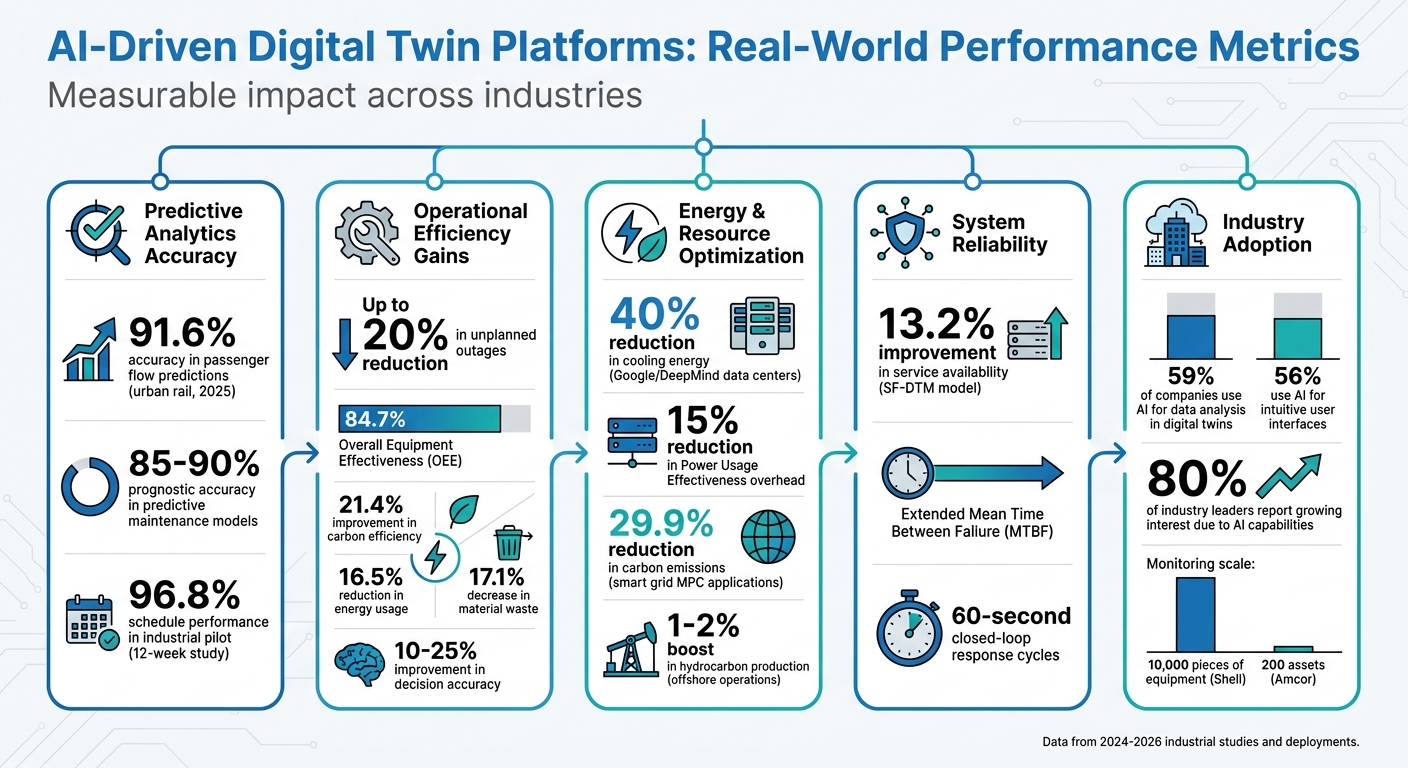
AI-Driven Digital Twin Platforms: Key Performance Metrics and Industry Results
Building Agentic AI-Powered Digital Twins for Manufacturing Operations
sbb-itb-ac6e058
Real-Time Monitoring and Predictive Analytics
Digital twin platforms have evolved significantly, moving from static monitoring to real-time intelligence. Traditional systems depended on periodic snapshots and manual analysis, often failing to catch critical issues before they spiraled into costly breakdowns. AI has revolutionized this process, enabling continuous analysis of sensor data to spot patterns that could indicate potential problems - long before they lead to downtime.
Anomaly Detection and System Analysis
AI-powered platforms now excel at detecting anomalies in real time by comparing live sensor data against historical trends and physics-based models. This combination enhances both accuracy and clarity. Using edge-cloud architectures, these systems can perform initial anomaly detection at the edge - right where sensors connect to equipment - while the cloud manages data storage and model coordination.
In May 2025, researchers Deepika Saxena and Ashutosh Kumar Singh introduced the SF-DTM (fault-tolerant digital twin management) model. By integrating Federated Learning with cosine similarity (SimiFed) and analyzing frequent fault-prone patterns, they achieved a 13.2% improvement in service availability and extended the Mean Time Between Failure (MTBF) for cloud-based digital twin applications. This system identifies sequences prone to faults and optimizes virtual machine allocation to avoid service interruptions.
This proactive approach sets the stage for more precise maintenance scheduling.
Predictive Maintenance with AI
Predictive maintenance shifts the focus from rigid calendar-based routines to schedules driven by data. AI harnesses both historical failure records and live sensor inputs to calculate the Remaining Useful Life (RUL) of critical components. This ensures maintenance teams can act at just the right moment, minimizing unnecessary interventions.
Real-world trials have underscored AI's value in maintenance optimization. For instance, Shell's 2024 initiative monitored 10,000 pieces of equipment globally, while Amcor deployed digital twins across 200 blow and injection molding assets, using multi-plant analytics to catch upstream issues . These efforts reduced unplanned downtime and improved maintenance timing.
Machine learning models used in predictive maintenance have demonstrated prognostic accuracies of 85–90%. As researchers Eldar Mardanov, Inese Mavlutova, and Biruta Sloka noted:
AI-enabled predictive maintenance systems, coupled with accurate digital twins of critical equipment, can reduce unplanned outages by up to 20%, extend asset life, and lower maintenance costs. - Eldar Mardanov, Inese Mavlutova, and Biruta Sloka
Research Findings in Industrial Applications
AI's capabilities in industrial applications continue to deliver measurable results. In February 2026, researchers Mingyuan Li, Chun-Ming Yang, Wei Lo, and Yi-Wei Kao conducted a 12-week industrial pilot using an AI-driven adaptive planning platform. Using a MO-PPO algorithm, the pilot achieved 96.8% schedule performance, 84.7% Overall Equipment Effectiveness (OEE), and a 21.4% improvement in carbon efficiency.
Other studies echo these findings. Industrial pilots featuring AI-driven adaptive planning have shown a 16.5% reduction in energy usage and a 17.1% decrease in material waste. In April 2025, Saikat Sarkar, a Maintenance Engineer at Chemtrade Refinery Service Inc., conducted a study involving 220 professionals in manufacturing and energy-intensive industries. The research revealed that AI-enabled digital twin capabilities significantly enhance predictive maintenance effectiveness, with a statistical coefficient of β = 0.58 and an R² value of 0.53.
Closed-loop cycles as short as 60 seconds allow for rapid responses to disruptions. These quick adjustments translate into real operational benefits, with AI-based decision support systems improving responsiveness and decision accuracy by approximately 10–25%.
Operations Optimization and Scenario Planning
AI is revolutionizing digital twin platforms, turning them into dynamic tools for decision-making that can fine-tune equipment settings, energy systems, and production schedules. This shift from reactive to proactive operations is changing how industries manage resources and prepare for future challenges. The result? More precise operations and better preparation through scenario testing.
AI-Driven Optimization Algorithms
Modern AI algorithms process both real-time and historical data to determine the best configurations almost instantly. Two standout approaches include Model Predictive Control (MPC) and Multi-Objective Reinforcement Learning (MORL).
- MPC is particularly effective in smart grid applications, where it has been shown to reduce carbon emissions by 29.9%.
- MORL, on the other hand, excels in balancing competing goals, such as increasing throughput, improving energy efficiency, and minimizing waste - objectives that often conflict in manufacturing environments.
A striking example of AI's impact comes from Google's collaboration with DeepMind between 2016 and 2018. Using machine learning, they optimized cooling systems in data centers, cutting cooling energy use by 40% and reducing overall Power Usage Effectiveness (PUE) overhead by 15%. By 2018, this system operated autonomously, recalibrating every five minutes to select the most energy-efficient actions while staying within safety limits.
Another notable case is the February 2026 deployment of a Production Optimization Oilfield Digital Twin by Capgemini and AWS. This integrated solution boosted hydrocarbon production by 1–1.5% for onshore wells and 1–2% for offshore operations by fine-tuning electric submersible pumps and fluid injection techniques.
These optimized setups feed directly into scenario planning, allowing digital twins to simulate and validate different strategies before they’re put into action.
Scenario Comparison and Policy Testing
Building on real-time optimizations, digital twins now enable extensive scenario testing, providing organizations with a safe space to explore countless "what-if" scenarios. This capability helps businesses make informed decisions without the risks of real-world experimentation.
Generative AI plays a crucial role here, analyzing vast possibilities to find the best configurations for sequencing, operational setpoints, and resource distribution. This is especially useful when balancing competing factors like throughput, energy consumption, and quality standards.
Recent industrial trials highlight the effectiveness of AI-driven scenario planning. For instance, research by Soori and colleagues found that AI-based decision support systems enhanced system responsiveness and decision accuracy by 10–25%. These advancements are helping industries not only improve efficiency but also make smarter, more confident decisions.
Data Processing and Accessibility Improvements
Digital twin platforms are now handling data faster and more efficiently than ever before. One of the biggest hurdles in deploying digital twins - collecting, filtering, and presenting data in a meaningful way - is being tackled head-on with these advancements.
Automated Data Filtering and Collection
AI has revolutionized how data is captured and processed, cutting setup times dramatically. During the initial data capture phase, AI zeroes in on the most critical data points while ignoring unnecessary details like temporary structures or equipment. Hexagon highlights this capability:
AI sharpens focus on critical data. It filters out unnecessary details, streamlines the process and reduces setup times.
This automated filtering ensures that digital twin models remain streamlined, avoiding wasted resources on irrelevant information.
The transition from manual to automated data collection is another game-changer. AI-powered drones and sensors can scan entire facilities in just minutes, replacing hours of manual labor. This speed is particularly essential in environments like manufacturing plants, where conditions change frequently, and keeping digital twins up to date is crucial for making accurate decisions.
Additionally, AI processes raw sensor data by using tools like spark‐r2r to convert it into RDF-based triple structures, creating lean and queryable models. This approach standardizes and labels data, making it easier to query across various systems. The result? "Twin graphs" - interconnected data models that show system relationships rather than isolated silos. These refined data structures feed directly into better visualization and user interaction.
Advanced Visualization and Dashboards
AI-powered dashboards are transforming how teams interact with complex data. By visualizing critical insights and highlighting trends, these tools help teams focus on what matters most. This enhanced visualization works seamlessly with the real-time monitoring and predictive analytics features discussed earlier, creating a more functional and user-friendly platform.
Adoption statistics show how central AI has become to digital twins: 59% of companies use AI for analyzing incoming data, while 56% use it to make user interfaces more intuitive. This focus on usability is breaking down barriers for non-technical users who may have struggled with complex data layers in the past.
Modern dashboards are also integrating generative AI chatbots, allowing users to interact with systems using natural language instead of specialized query languages. Combined with real-time 3D rendering - converting LiDAR scans and point clouds into formats like glTF or USD - these dashboards provide both visual clarity and intelligent assistance for troubleshooting and decision-making. Together, these features empower teams to make quicker, more informed decisions by simplifying data interpretation and improving accessibility across devices.
Cross-Device and Remote Accessibility
AI ensures a consistent, real-time view across all devices - whether on desktops, tablets, or mobile phones. For teams spread across different locations, remote engineers can collaborate within shared spatial visualizations without needing to be physically present.
This technology also supports "Augmented Worker" scenarios, where remote operators use AR/VR headsets or mobile devices to access context-aware 3D environments, live video feeds, and sensor data all at once. Heavy computational tasks are handled in the cloud, allowing high-quality graphics to be streamed to lightweight devices that can’t process complex 3D models on their own.
Platforms like Anvil Labs are leading the way in cross-device accessibility. They support multiple data types, including 3D models, 360° photos, thermal imagery, LiDAR, and orthomosaics, while integrating with AI analysis tools and task management systems. These innovations are turning digital twin platforms into collaboration hubs. It’s no surprise that 80% of surveyed leaders across 11 industries report growing interest in digital twins due to AI’s capabilities.
Challenges and Governance in AI-Driven Digital Twin Platforms
Even with the efficiency AI brings to digital twin platforms, certain hurdles persist - especially in areas like data security, integration complexity, and governance. These challenges often determine whether these platforms can transition from concept to practical use.
Data Security and Privacy Considerations
When AI analyzes sensitive industrial data in real time, ensuring its protection becomes a top priority. If operational data falls into the wrong hands, it could expose vulnerabilities in crucial infrastructure. This makes security orchestration a critical component. As C. Islam and colleagues describe:
Security Orchestration is the planning, integration, cooperation, and coordination of the activities of security tools and experts to produce and automate required actions in response to any security incident across multiple technology paradigms.
To combat threats, organizations are adopting frameworks like SOAR4BC (Security Orchestration, Automation, and Response for Business Continuity). These systems merge real-time data from digital twins with insights from tools like Intrusion Detection Systems and firewalls, creating a unified security view. Through Deep Reinforcement Learning, they also generate standardized playbooks - aligned with the CACAO v2 specification - to address security incidents either autonomously or with human intervention.
On the infrastructure side, Software-Defined Networking (SDN) controllers and tools like Open Policy Agent are being used to manage dynamic access control policies across industrial networks. Meanwhile, platforms like Unity Catalog centralize data governance, helping organizations handle sensitive data while complying with regulations.
Integration with Existing Infrastructure
Blending AI capabilities with legacy systems and cloud infrastructures is no small feat. It often requires substantial investments in both high-performance computing resources and skilled professionals to effectively develop AI-powered digital twins.
One of the biggest roadblocks is the absence of standardized frameworks. Without them, data interoperability issues arise, making it hard to scale or implement these systems in practical settings. Hybrid architectures, such as the AWS Digital Twin Framework, aim to address this by using tools like TwinFlow and Amazon Managed Workflows for Apache Airflow to continuously recalibrate models based on changing physical conditions.
Another approach involves Knowledge Graphs, which transform raw sensor data into structured RDF (Resource Description Framework) triples. This method creates flexible twin models capable of bridging older systems with modern AI solutions.
Governance and Ethical AI Use
While AI enhances digital twin functionality, its decision-making processes often lack transparency. This "black box" nature can erode trust, especially in critical industrial applications where autonomous decisions carry significant stakes. To tackle this, Explainable AI (XAI) is becoming a necessity.
Organizations are turning to human-in-the-loop (HITL) governance models to maintain clarity and control. For example, natural language interfaces like Chat4XAI explain AI's reasoning in straightforward terms, ensuring operators understand why certain actions are recommended. Similarly, techniques like XRL-DINE (eXplainable Reinforcement Learning) provide localized explanations for decisions made by autonomous agents, offering insights into their logic.
Standardized playbooks, aligned with the CACAO v2 specification, are also playing a key role. These playbooks document and automate incident response procedures, ensuring consistency and enabling cross-organizational sharing. Tools like Anvil Labs further support governance by enabling secure data sharing and integrating with AI analysis platforms. This ensures teams can collaborate effectively while keeping AI processes transparent and accountable.
Conclusion
AI integration has elevated digital twin platforms from simple monitoring tools to powerful decision-making systems. As The Planet Cloud insightfully states:
The digital twin is not complete until it changes behavior.
This shift brings real-world benefits, like predictive maintenance, which can identify issues such as bearing wear and cavitation before they lead to costly downtime.
By combining physics-based models with machine learning, hybrid systems are able to adapt and improve continuously. Early examples, like Amcor's deployment, showcase how these tools enhance anomaly detection and optimize maintenance strategies.
Looking ahead, the fusion of generative AI with digital twins is laying the groundwork for smarter, closed-loop network management. Advances in cloud technology, including faster microsecond-scale performance and standardized frameworks like OPC-UA, are making scalability more practical. Ajit Daundkar from the IEEE Computer Society emphasizes this point:
AI-powered digital twin technology is poised to become a cornerstone of modern business strategy.
However, the real value lies in integration rather than just visualization. Success depends on maintaining consistent asset semantics and embedding workflows into operations. Businesses that launch impactful pilot projects, keep AI models updated, and prioritize high-quality alerts will fully realize the potential of AI-enhanced digital twins. Platforms like Anvil Labs play a key role by enabling secure data sharing and incorporating AI-driven analysis tools, ensuring teams can collaborate efficiently while upholding transparency and accountability.
FAQs
What data do I need to build an AI-powered digital twin?
To create an AI-powered digital twin, having precise and reliable data that mirrors the physical system or environment is crucial. The main types of data you'll need include:
- Sensor data: Information like temperature, vibration levels, and pressure readings.
- Spatial data: Inputs such as LiDAR scans, 3D models, or satellite images.
- Historical data: Past records that help identify trends and patterns.
Ensuring the data is clean, well-organized, and capable of real-time streaming is vital for keeping the twin synchronized, enabling effective monitoring, and supporting predictive analytics.
How do AI digital twins integrate with legacy systems?
AI-powered digital twins work seamlessly with legacy systems by leveraging real-time data from IoT sensors and other sources, processed in the cloud. This approach keeps them in sync with physical assets, enabling capabilities like real-time monitoring, predictive maintenance, and operational enhancements. By using containerized deployment and serverless execution, these systems manage heavy workloads effectively. They also convert legacy data into formats that AI can process, modernizing operations without the need for expensive hardware upgrades or complete system overhauls.
How can I secure real-time digital twin data in the cloud?
Securing real-time digital twin data in the cloud requires platforms that combine scalable storage, powerful processing capabilities, and strong security measures. A few key strategies help ensure this:
- IoT Sensors and AI: These tools are essential for monitoring and analyzing data securely. IoT sensors gather real-time information, while AI processes and analyzes it, ensuring the data remains protected throughout.
- Containerized or Serverless Architectures: These architectures not only enhance scalability and data integrity but also strengthen security. They allow for better synchronization of digital twin data while reducing vulnerabilities.
With these approaches, digital twins can operate efficiently and securely in real-time cloud environments.

.svg)


