

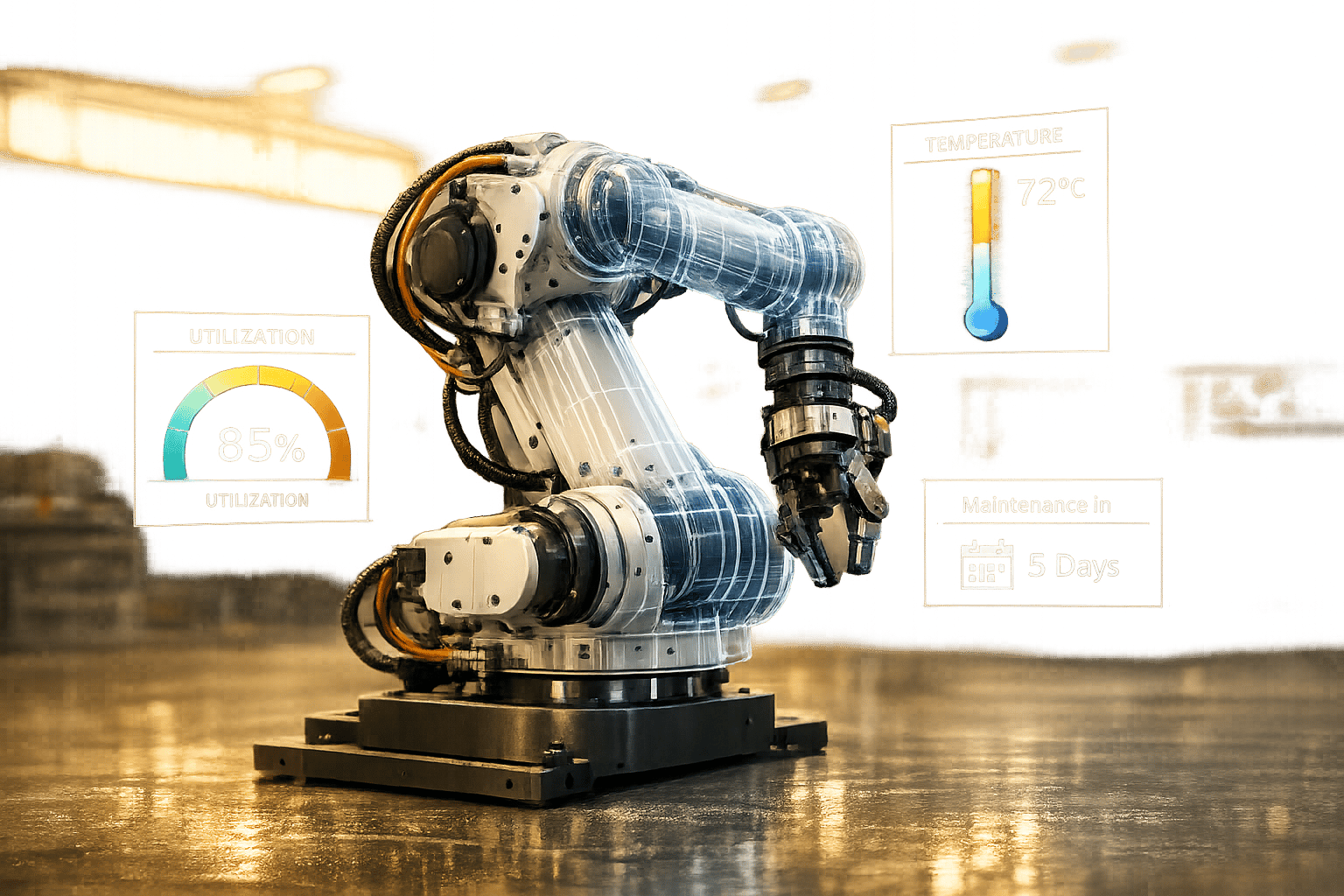
Digital twins are real-time virtual replicas of physical equipment that help businesses optimize operations, reduce downtime, and cut costs. By continuously collecting sensor data - like temperature, pressure, and vibration - these models provide actionable insights into equipment performance, predict failures, and streamline maintenance schedules. Companies using digital twins report ROI improvements, with over half seeing returns above 20%.
Key benefits include:
- Improved equipment monitoring: Real-time data highlights inefficiencies and potential issues.
- Predictive maintenance: Prevents costly breakdowns by addressing problems early.
- Resource optimization: Simulations allow testing of changes without disrupting operations.
- Cost savings: Reduces unplanned downtime and maintenance expenses.
Anvil Labs simplifies digital twin creation and management with a user-friendly platform that integrates data from LiDAR, thermal imagery, and more. The result? Smarter decisions, extended equipment life, and better resource allocation - all at a predictable cost of $49 per project.
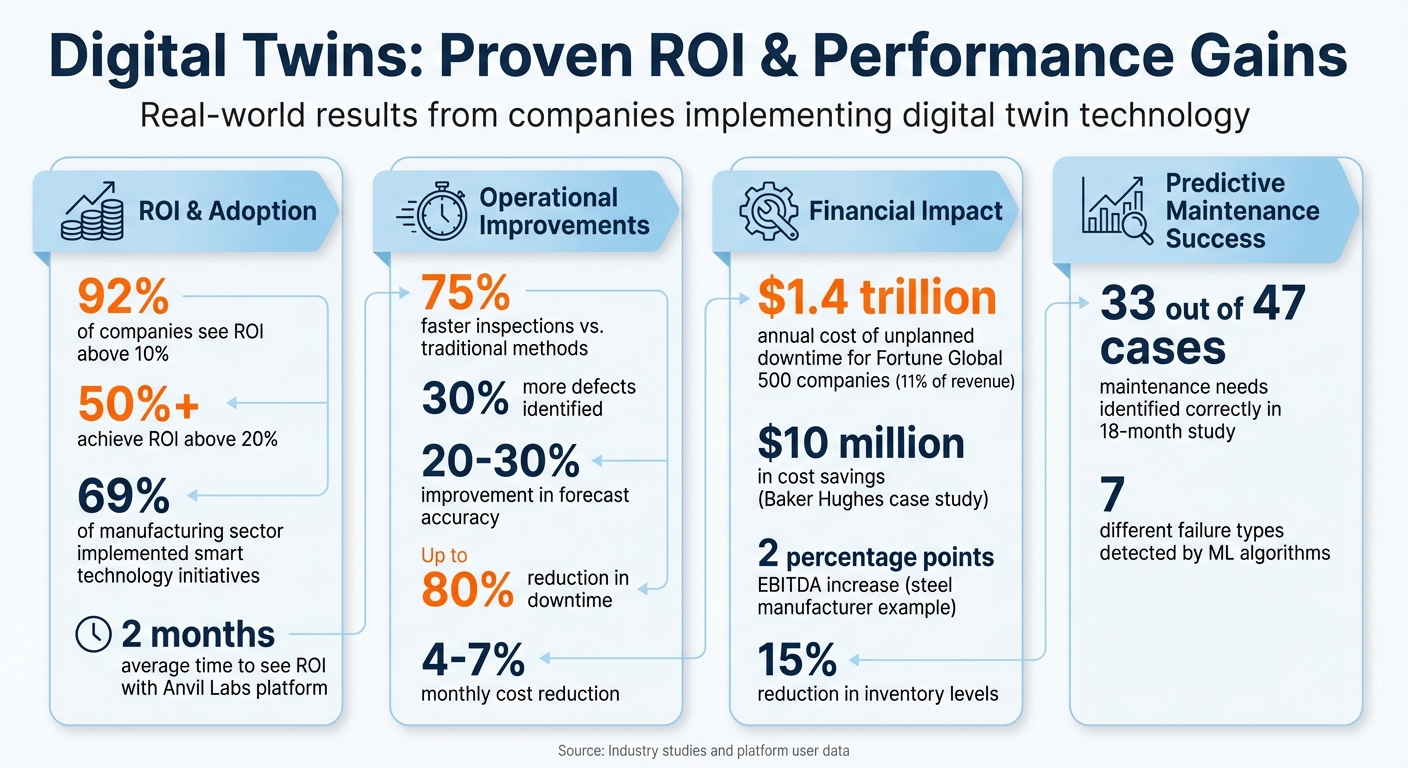
Digital Twin ROI and Performance Impact Statistics
Building Digital Twins with Anvil Labs

Anvil Labs Platform Features
Anvil Labs provides a cloud-based platform designed to simplify the creation and management of digital twins. It hosts 3D models, processes raw data into usable formats, and includes annotation and measurement tools for tasks like marking equipment wear, measuring distances, and analyzing utilization spaces on virtual replicas. To protect sensitive data, the platform uses role-based access controls, ensuring only authorized personnel can access critical information.
The platform's drag-and-drop interface makes it easy to upload various data types, whether pre-processed models or raw data, with over 20 deliverable options available. Once processed, digital twins are accessible through a password-protected cloud viewer that works seamlessly on desktops, tablets, and smartphones. Angel Rojas of Red Angel Drones highlights the platform's value, stating:
The efficient workflow delivers clear ROI from the first use.
These tools create a solid foundation for integrating diverse data sources into comprehensive digital twins.
Integrating Data Sources
To construct an accurate digital twin, multiple data streams must come together in a unified model. Anvil Labs supports this by integrating LiDAR scans for detailed 3D mapping, 360° photos for immersive walkthroughs, thermal imagery for heat detection, and orthomosaics for aerial perspectives. For instance, creating a digital twin of a pump might involve using LiDAR to capture its geometry, thermal imagery to identify heat patterns, and annotation tools to document inefficiencies. These models enable teams to simulate usage scenarios and plan changes without physical interventions.
Users can either collect data themselves or tap into Anvil Labs' extensive network of over 10,000 drone pilots across the country. The platform's processing capabilities have significantly streamlined inspections, allowing users to complete them 75% faster than traditional methods while identifying 30% more defects. This unified approach ensures real-time, device-agnostic access for teams.
Cross-Device Access for Teams
With Anvil Labs, team members can access digital twins from virtually anywhere, thanks to web and mobile interfaces. The platform offers customizable viewing options and integrates with tools like Matterport for 3D scans, YouTube for video overlays, AI tools for predictive insights, and task management systems for maintenance workflows. By enabling remote analysis, it removes the need for on-site visits, saving time and resources.
Its per-project pricing model - set at $49 per project for hosting, sharing, and management - keeps costs predictable. Most users report seeing ROI within two months of adopting the platform. These features empower distributed teams to make informed, data-driven decisions, improving equipment efficiency and overall utilization.
Real-Time Equipment Monitoring
Monitoring Equipment Performance
Real-time monitoring takes the concept of digital twins to the next level by offering deeper operational insights. A digital twin continuously gathers data from PLCs, sensors, and IoT devices, tracking key metrics like cycle times, temperature, and vibrations. This data feeds into a real-time 3D visualization of equipment performance, giving operators a clear and immediate view.
The integration of spatial context is a game-changer. Performance data is layered directly onto a 3D model of the facility, making it easier to pinpoint issues. For example, abnormal temperature readings can prompt checks for nearby heat sources or inadequate ventilation. This spatial perspective helps operators differentiate between equipment malfunctions and environmental factors.
Additionally, combining spatial data with performance metrics enables a more thorough analysis of production interruptions. Digital twins can log "blocked" time (when equipment is idle, waiting for the next step in production) and "starved" time (when it’s waiting for materials to arrive) at key bottleneck points. These insights uncover disruptions in production flow that might otherwise go unnoticed, even when individual machines seem to be functioning. By incorporating historical inspection records and original manufacturing specifications, the system can set alarms to flag potential failures before they escalate.
Identifying Equipment Inefficiencies
Real-time tracking highlights the discrepancy between how equipment is supposed to perform and how it actually operates on the factory floor. Digital twins compare the intended performance against real-world results, exposing underutilized machines or those overworked to the point of creating bottlenecks. This transparency enables managers to redistribute tasks or tweak schedules to enhance Overall Equipment Effectiveness (OEE).
The data also identifies inefficient operating parameters, such as settings that unnecessarily increase energy consumption or accelerate wear without boosting productivity. Unplanned downtime costs Fortune Global 500 companies an estimated $1.4 trillion annually, equating to about 11% of their annual revenue. By detecting anomalies through tools like thermal imaging or vibration monitoring, teams can shift from routine maintenance schedules to condition-based maintenance. This approach addresses problems as soon as early warning signs appear, helping to prevent costly failures. These real-time insights play a critical role in crafting maintenance strategies that minimize disruptions and extend equipment life.
AI-Powered Asset Monitoring Solution: Digital Twin Starter Kit
Predictive Maintenance with Digital Twins
Using digital twins for predictive maintenance improves equipment efficiency by minimizing unexpected breakdowns and fine-tuning operational schedules.
Preventing Equipment Failures
Predictive maintenance shifts the approach from fixing problems after they occur to addressing them before they happen. Digital twins play a key role here by comparing real-time sensor data from physical equipment to the expected behavior of their virtual models. Any mismatch can indicate wear or an impending failure.
Real-world failure data is often limited or risky to gather. Digital twins address this by simulating fault scenarios, like worn bearings, leaking seals, or blocked inlets, to create synthetic sensor data. For instance, Baker Hughes used this method with their fleet of fracturing trucks, collecting nearly a terabyte of pump data. By applying signal-processing and machine-learning techniques, they distinguished between healthy and failing pumps, cutting costs by $10 million.
Machine learning models trained on simulated data can detect early warning signs, such as pressure surges or unusual vibration patterns. In one case, engineers built a digital twin of a triplex pump using MATLAB and Simulink. They simulated 200 scenarios and ran thousands of simulations to train an algorithm capable of identifying seven different failure types. This algorithm was later installed on the actual machine's control unit for real-time monitoring.
"Predictive maintenance helps engineers determine exactly when equipment needs maintenance. It reduces downtime and prevents equipment failure by enabling maintenance to be performed based on need rather than a predetermined schedule." - Samvith Vasudeva Rao, Global Chemical and Petroleum Industry Manager, MathWorks
These predictive capabilities not only avert equipment failures but also make maintenance operations more efficient.
Reducing Maintenance Costs and Downtime
Beyond failure prevention, predictive maintenance lowers costs by enabling timely action. In manufacturing, unexpected downtime can cost thousands of dollars per minute. Digital twins help avoid these losses by identifying issues early, enabling repairs to be scheduled during planned downtimes.
Over an 18-month study of industrial processes, digital twin methods identified maintenance needs in 33 out of 47 cases. This accuracy allows teams to address minor issues before they escalate, extending equipment life and optimizing repair schedules.
Additionally, a 2022 survey revealed that 69% of manufacturing sector respondents had implemented smart technology initiatives, with nearly two-thirds focusing on cost reduction. Predictive maintenance also trims costs by reducing spare parts inventories and emergency repair labor. By focusing on high-impact assets - where failures are most disruptive or costly - companies can maximize the benefits of their predictive maintenance strategies.
sbb-itb-ac6e058
Optimizing Resource Allocation Through Simulation
Digital twins take the power of real-time monitoring and predictive maintenance a step further by enabling managers to simulate operational changes without disrupting production. This capability allows teams to test adjustments - like modifying batch sizes, redesigning layouts, or experimenting with new product combinations - before dedicating time and resources to them.
Simulating Equipment Usage Scenarios
One of the standout features of digital twins is their ability to simulate a wide range of production sequences, helping to identify bottlenecks and inefficiencies. For example, they can pinpoint where equipment is underutilized or blocked, shedding light on underperforming areas and wasted resources.
Take the case of a metal fabrication plant: an AI-driven agent, trained using reinforcement learning, worked within the plant's digital twin to optimize batch sizes and production schedules. The system evaluated thousands of product combinations across four parallel production lines, leading to lower costs and more consistent yields compared to manual approaches. Similarly, Siemens leveraged digital twins during the relocation of its Berlin facility. By virtually staging equipment and confirming spatial fit with 99% accuracy, the company avoided costly on-site errors by remotely adjusting asset placement.
Digital twins also make it possible to test procedures virtually before implementing them, a process known as offline commissioning. This includes running "what-if" scenarios to predict how factors like rising fuel costs, increased demand, or shifting facility locations might impact supply chain expenses. These insights empower companies to make smarter, data-driven decisions about resource allocation.
Using Data for Better Decisions
The simulation capabilities of digital twins provide actionable insights that help businesses allocate resources more effectively. For instance, a steel manufacturer used its digital twin to model the relationships between hundreds of assets and warehouses. By forecasting risks 12 weeks in advance, the company was able to adjust its production plans, boosting EBITDA by 2 percentage points and cutting inventory levels by 15%.
Early adopters of this technology report impressive results, including improving forecast accuracy by 20–30% and reducing downtime by up to 80%. Digital twins can even automate optimized supply plans and resource scheduling based on simulation data. In practice, companies using digital twins for these purposes often see monthly cost reductions of 4–7%.
"By simulating future operational scenarios with digital twin models and machine learning predictive analytics, owners/operators can optimize their resources, processes, and maintenance schedules, strategies, and setups." - Matt Hula, Process Engineering Resource Manager, Anvil Corporation
Analyzing Utilization Metrics
Once simulation and testing are complete, it's time to dive into the numbers. Tracking key metrics is essential for evaluating equipment performance. Digital twins simplify this process by collecting real-time data and comparing it to baseline measurements and original design specs. This approach ensures you’re working with accurate, actionable insights.
Key Equipment Utilization Metrics
Measuring performance involves focusing on several critical areas. Utilization metrics keep track of operating hours, uptime versus downtime, and overall capacity. These figures help identify whether assets are overworked or sitting idle. Performance metrics - like cycle times, throughput, and first-pass yield - highlight production bottlenecks. Condition metrics, gathered from IoT sensors, monitor factors like temperature, vibration, pressure, and energy usage, helping predict potential failures before they happen. Lastly, operational visibility metrics provide insights into asset location and technician response times, improving resource allocation.
Digital twins also shine a light on idle time, breaking it down into starved and blocked periods. These inefficiencies can quietly drain profitability if left unaddressed.
Making Continuous Improvements
Metrics are only as useful as the actions they inspire. Digital twins provide a solid foundation for improvement by offering a clear baseline and a safe space to test new strategies. Start by using 3D scans and historical data to map out your current state. Then, program original manufacturing guidelines as alarm thresholds to notify operators when performance veers off course. With continuous monitoring and small, iterative adjustments, you can achieve meaningful productivity gains over time.
Conclusion
Digital Twins for Industrial Efficiency
Digital twins present a cutting-edge way to enhance industrial operations. By combining real-time monitoring with predictive analytics, they help reduce downtime, extend the lifespan of assets, and improve overall efficiency - all while delivering a strong return on investment. In fact, over half of companies using digital twins report at least a 20% ROI, with 92% seeing returns above 10%. These virtual models allow teams to test changes without risk, uncover bottlenecks that traditional methods might overlook, and shift from reactive problem-solving to proactive planning. The result? Longer asset life, lower maintenance costs, and smarter use of resources.
How Anvil Labs Supports Digital Twin Applications
Anvil Labs provides the tools and infrastructure needed to harness the full potential of digital twins. Their platform enables teams to create and manage digital twins using cloud-based 3D models, real-time sensor data, and seamless access across devices. Operators can attach SOPs and maintenance records directly to virtual equipment with annotation and measurement tools, creating a centralized hub for operational insights. Secure sharing ensures critical data is always accessible, while integrations with Matterport, AI-driven analysis tools, and task management systems streamline processes from data collection to decision-making. By leveraging these capabilities, organizations can boost efficiency and make smarter, data-driven choices.
FAQs
How can digital twins help prevent equipment failures?
Digital twins play a key role in avoiding equipment failures by analyzing real-time sensor data to spot irregular patterns, like unexpected temperature spikes or unusual vibrations. This analysis provides an opportunity for predictive maintenance, allowing teams to address potential issues before they turn into major problems.
With this approach, digital twins help boost equipment reliability, minimize downtime, and increase the longevity of industrial assets.
What types of data are needed to build a digital twin?
To build a digital twin, you need to gather a mix of real-time data and historical information related to the physical asset or system. This often involves pulling in sensor readings, operational statistics, and external contextual details. By combining these data streams, digital twins enable precise visualization, simulation, and analysis, helping to improve equipment performance and maximize its use.
How do digital twins enhance equipment utilization and resource allocation?
Digital twins improve how equipment is used by creating real-time virtual replicas of physical assets. These digital models let organizations track performance, predict problems before they occur, and fine-tune operations. The result? Fewer disruptions, better-planned maintenance, and smarter use of resources like labor and materials.
By spotting inefficiencies and anticipating failures, digital twins support proactive resource management. This means less waste, lower costs, and resources being directed to where they're most needed - all of which boosts efficiency in industrial operations.

.svg)


